
Perforated Sheets and Perforated Metal Pans
Strong metal sheets with precise perforations, suitable for filtration, ventilation, screening and protection
- Available with round holes, square holes or slotted perforations.
- Available in aluminium, steel, galvanised steel, stainless steel 304 and stainless steel 316.
Perforated Sheets
Perforated sheets, also called perforated metal panels, are metal sheets in which openings are made according to a fixed pattern. By combining sheet thickness, perforation shape, hole size and pitch, a strong and functional sheet material is created with a controlled open area.
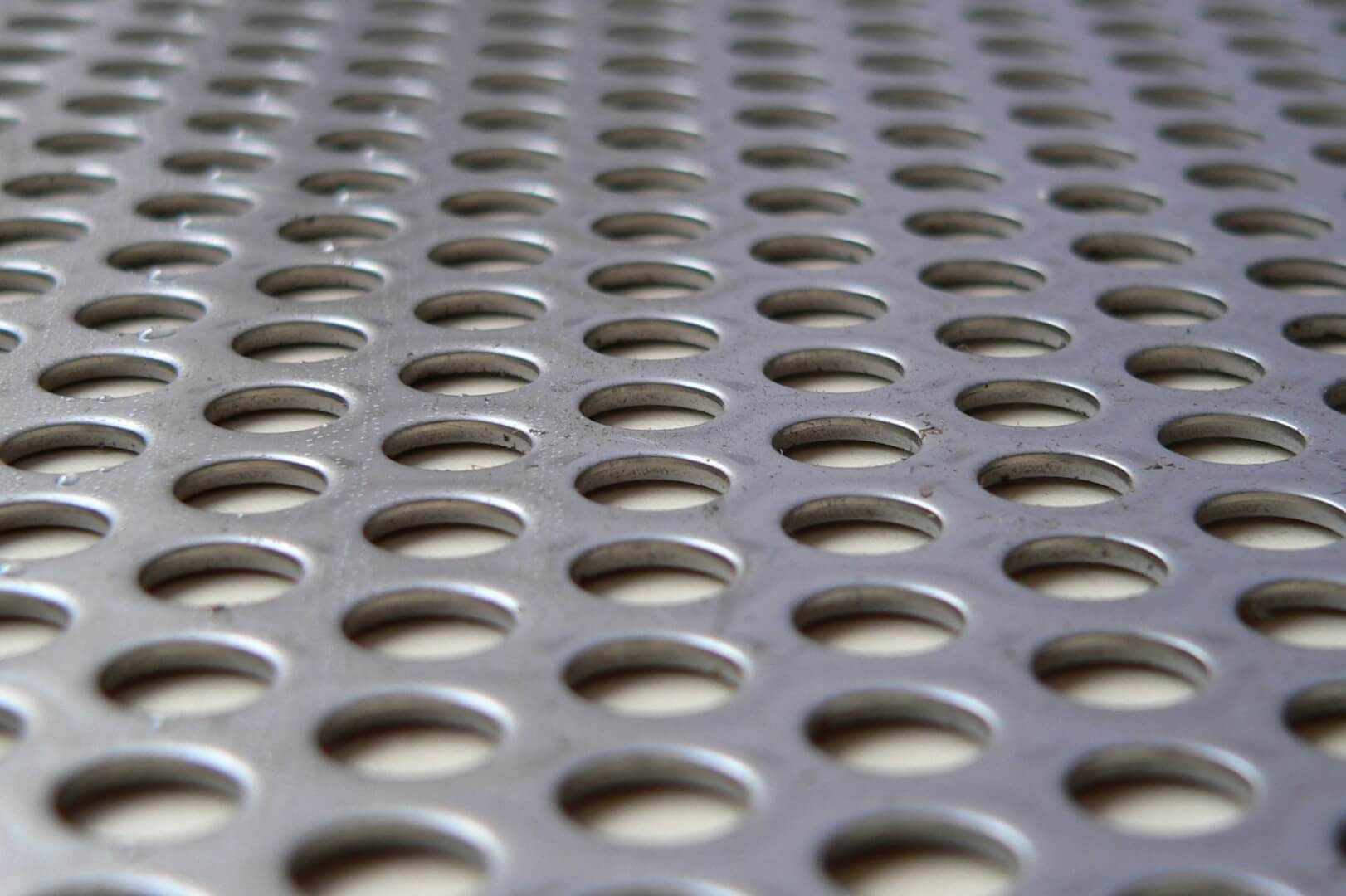

Perforated sheets for industry, construction and technical applications
Perforated sheets are used for filtration, ventilation, screening, machine guarding, security, façade cladding, interior applications and technical constructions.
They combine the rigidity of sheet material with the permeability of an open structure.

Round perforation is suitable when:
- a strong and uniform perforation structure is required
- air, light or liquid passage is important
- the sheet is used for filtration, ventilation or screening
- a technical and neutral appearance is desired
Round perforation
Round perforation is the most commonly used version. The round holes provide a good balance between strength, open area and easy processing. This type is often chosen for ventilation, filtration, machine guarding, security and general industrial applications.

Square perforation is suitable when:
- a clean and regular appearance is desired
- openness and visibility are important
- the sheet is used for decoration, screening or technical panels
- a more open visual effect is required
Square perforation
Square perforation gives a cleaner and more geometric appearance. Thanks to the straight shape, it creates a more visually open character than round perforation with a similar pitch. This type is used for screening, decorative applications, sieving and architectural panels.

Slotted perforation is suitable when:
- directional passage is required
- air, water or material must pass through efficiently
- the sheet is used for sieving, grilles, ventilation or drainage
- an elongated technical pattern is desired
Slotted perforation
Slotted perforation consists of elongated openings. This version is suitable for applications where airflow, water drainage, sorting or directional passage are important. The slots can be placed in the length or width direction of the sheet.

Decorative perforation is suitable when:
- appearance and function need to be combined
- a unique pattern or visual effect is desired
- the sheet is used in architecture, interiors or design
- light, visibility and screening are all important
Decorative perforation
In addition to standard perforations, decorative patterns are also possible. These are used for interior applications, shopfitting, wall cladding, ceilings, furniture, façade accents and visible design work.
Technical properties of perforated sheets
- made from flat sheet material
- available with round, square, slotted or decorative perforations
- controlled open area
- good combination of rigidity and ventilation
- suitable for filtration, screening, protection, security and design
- available in different sheet thicknesses and dimensions
- available in aluminium, steel, galvanised steel, stainless steel 304 and stainless steel 316
- suitable for cutting, folding, welding, painting or powder coating
- applicable as standard sheet or custom-made panel
Advantages of perforated sheets
Strong and dimensionally stable
Perforated sheets retain the basic rigidity of sheet material, while the perforations provide open passage. This makes them suitable for applications where stability and flow are both required.
Controlled open area
The perforation determines how much air, light, liquid or material can pass through the sheet. By selecting the hole size, pitch and open area, the sheet can be accurately matched to the application.
Wide choice of perforation patterns
Round holes, square holes, slots and decorative patterns each provide a different technical and visual effect. This allows perforated sheets to be used both functionally and aesthetically.
Suitable for custom work
Perforated sheets can be cut, folded, framed or processed into larger constructions. This makes them suitable for both simple panels and technical components.
Durable material
Depending on the environment, aluminium, galvanised steel or stainless steel can be selected. This keeps the sheet suitable for indoor use, outdoor use, humid environments or industrial applications.
What are perforated sheets used for?
Filtration and sieving
Perforated sheets are used as coarse filters, sieve plates, support plates or pre-filters in technical installations. The perforation determines which particles are allowed through and which are retained.
Ventilation and air grilles
Thanks to their open structure, perforated sheets are suitable for ventilation panels, air grilles, technical cabinets, machine covers and HVAC applications. They allow air to circulate while providing protection.
Machine guarding and security
Perforated sheets can shield moving parts, machines and technical areas. They provide protection while still allowing visibility, airflow and inspection.
Façade cladding and architecture
Perforated sheets are used for façades, balustrades, sun shading, wall cladding and ceilings. Through the choice of perforation, material and finish, the appearance can be adapted to the design.
Interior and decoration
Decorative perforated sheets are suitable for shopfitting, furniture, partition walls, ceilings, acoustic panels and wall cladding.
Industry and technical constructions
In production environments, perforated sheets are used as protective plates, cover plates, partition panels, grilles, filter supports, transport components or parts of machines and installations.


Material choice for perforated sheets
Aluminium perforated sheets
Aluminium perforated sheets are lightweight, corrosion-resistant and easy to process. They are often chosen for ventilation panels, interior applications, façade cladding, decoration and applications where weight is important.
Mild steel perforated sheets
Mild steel is strong, easy to process and suitable for dry indoor environments or applications where the sheet will later be painted, coated or further treated. It is a practical choice for technical panels, machine construction and general industrial applications.
Sendzimir galvanised perforated sheets
Sendzimir galvanised steel has a protective zinc coating and is suitable for applications where additional corrosion protection is required. It is used for screening, ventilation, agriculture, technical applications and outdoor environments with limited to normal corrosion exposure.
Stainless steel 304 perforated sheets
Stainless steel 304 is a widely used choice for applications where corrosion resistance, hygiene and a clean finish are important. It is used in industry, food processing, interiors, machine construction and technical environments.
Stainless steel 316 perforated sheets
Stainless steel 316 offers higher corrosion resistance than stainless steel 304 and is suitable for humid, saline or chemically exposed environments. It is used in water treatment, chemical processing, coastal areas, the food industry and demanding outdoor applications.
Dimensions, perforations and customisation
Perforated sheets are available in different sheet thicknesses, perforation shapes, hole sizes, pitches and panel formats. The right choice depends on the required strength, open area, appearance and mounting method.
Customisation is possible in:
- perforation shape
- hole diameter or slot size
- pitch and pattern
- open area
- sheet thickness
- panel size
- material type
- unperforated margins
- cutting
- folding
- welding
- surface treatment
- mounting in a frame or construction
For technical applications, not only the opening is considered, but also the sheet thickness, bridge between the holes, edge distance, load capacity and further processing.


Points to consider with perforated sheets
With perforated sheets, edge finishing and perforation distribution are important. Standard stock sheets often have unperforated margins. These are solid strips along one or more sides of the sheet. In custom-made panels, these unperforated margins can be adapted to the mounting method or desired appearance.
When a sheet is cut from a larger format, half holes may appear along some edges. This is normal for perforated sheets cut from stock material. For visible work, façade panels or accurate mounting, an adjusted edge layout or symmetrical pattern can be provided.
The relationship between hole size, bridge and sheet thickness is also important. A bridge that is too small or a perforation that is too large in relation to the sheet thickness can affect strength and processability. That is why perforation, sheet thickness and application should be considered together.
For sheets that are folded, welded or mounted, bending lines, fixing points, edges and free zones without perforation must be taken into account in advance.
When should you choose perforated sheets?
Perforated sheets are the right choice when a flat, strong and open sheet material is required. They combine protection, ventilation, filtration and design in one product.
Choose perforated sheets when:
- a controlled open area is required
- air, light, liquid or material must pass through
- a strong and flat sheet structure is desired
- machine guarding or technical screening is required
- filtration, sieving or ventilation is important
- a decorative or architectural pattern is desired
- the material needs to be cut, folded or framed
- a durable solution is required in aluminium, steel, galvanised steel or stainless steel
Compared with expanded metal, a perforated sheet has a flatter and more regular perforation pattern. Compared with woven mesh, a perforated sheet is more rigid and better suited as a self-supporting panel. Compared with solid sheet, perforated sheet offers more ventilation, light transmission and weight reduction.